Is LLM the new database?
Hyper-compressed, probabilistic databases of tomorrow
LLMs have been touted as technological step-ups across multiple domains : as reasoning engines, user interface, agentic substrates etc. I'd audaciously argue this overlooks their most disruptive architectural property: they are hyper-compressed, probabilistic databases.
It seems like we are operating in the "txt" era of neural computing. Early computing relied on unstructured text files before the relational model gave us SQL, can it be that what today's AI stack treats the Model as a black-box processor be rather better suited as a data store?
Today, because we cannot trust the model’s internal memory to be precise, we surround it with massive scaffolding - Vector Databases and RAG pipelines. We are essentially bolting external RAM onto a CPU because we don't know how to reliably write to the Hard Drive.
This approach, while functional, seems like an architectural patch. It ignores the reality that the model itself holds a compressed representation of the world.
If this angle is valuable, we will see a move from "Retrieval" (finding external documents) to "Recall" (accessing internal weights).
THE PHYSICS OF COMPRESSION: PETABYTES TO GIGABYTES
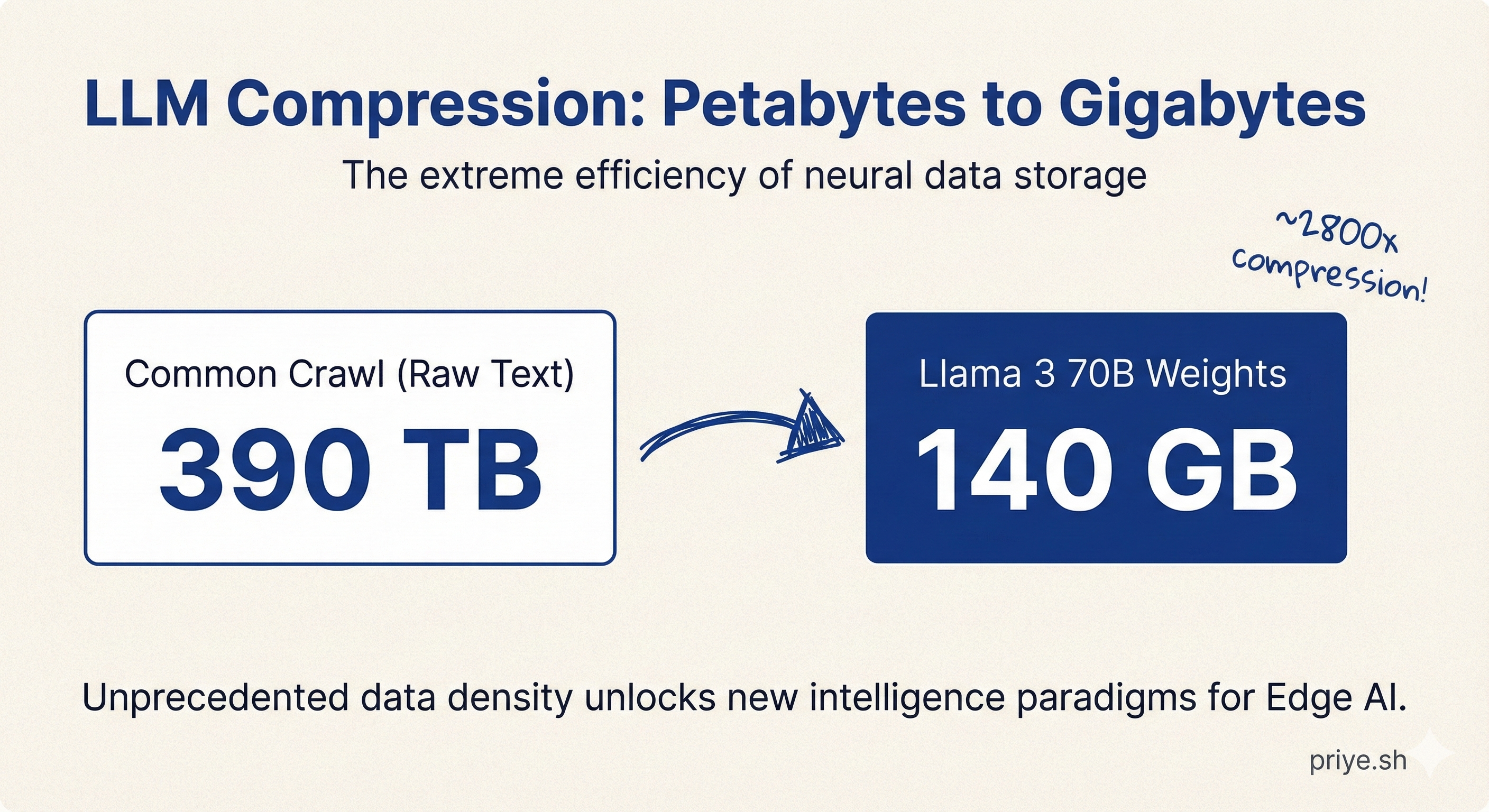
To understand the magnitude of the opportunity, we must look at the data physics. Consider the raw input. The Common Crawl dataset, widely used as a proxy for the internet's text layer, is massive (May/June 2023 snapshot alone contains approximately 390 TB of uncompressed content. Yet, when we train a frontier model like Llama 3 70B on roughly 15 trillion tokens of such data, the resulting model weights fit into a file size of roughly 140 GB.
That represents a compression ratio of roughly 2,800:1 relative to the raw source. This degree of compression allows us to fit a functional approximation of human knowledge onto a high-end consumer GPU, or with 4-bit quantization, onto a local edge server. This is not just an efficiency gain; it is a paradigm shift in data locality.
However, this compression comes at a cost. The data is "holographic" - distributed across billions of parameters. We know the "autonomy of Greenland" is stored somewhere in those 70 billion weights, but we don't know which specific neurons hold it, nor can we easily update it if anything changes.
THE 'READ' PROBLEM: MECHANISTIC INTERPRETABILITY AS QUERY LANGUAGE
Current method of extracting information from LLMs is inference, not reading. We prompt the model ("What is the capital of France?") and hope the probability distribution aligns with reality.
To treat an LLM as a database, we need Mechanistic Interpretability - the science of reverse-engineering the neural circuitry to locate specific facts.
Recent work from Anthropic provides a glimpse of the solution. In their research on "Golden Gate Claude," they used Sparse Autoencoders (SAEs) to identify specific features within the model. Crucially, they found that features are not stored in single neurons, but as directions in activation space. Because models use superposition (storing more features than they have neurons), a single neuron might participate in representing "The Golden Gate Bridge," "Sarcasm," and "Korean BBQ" simultaneously.
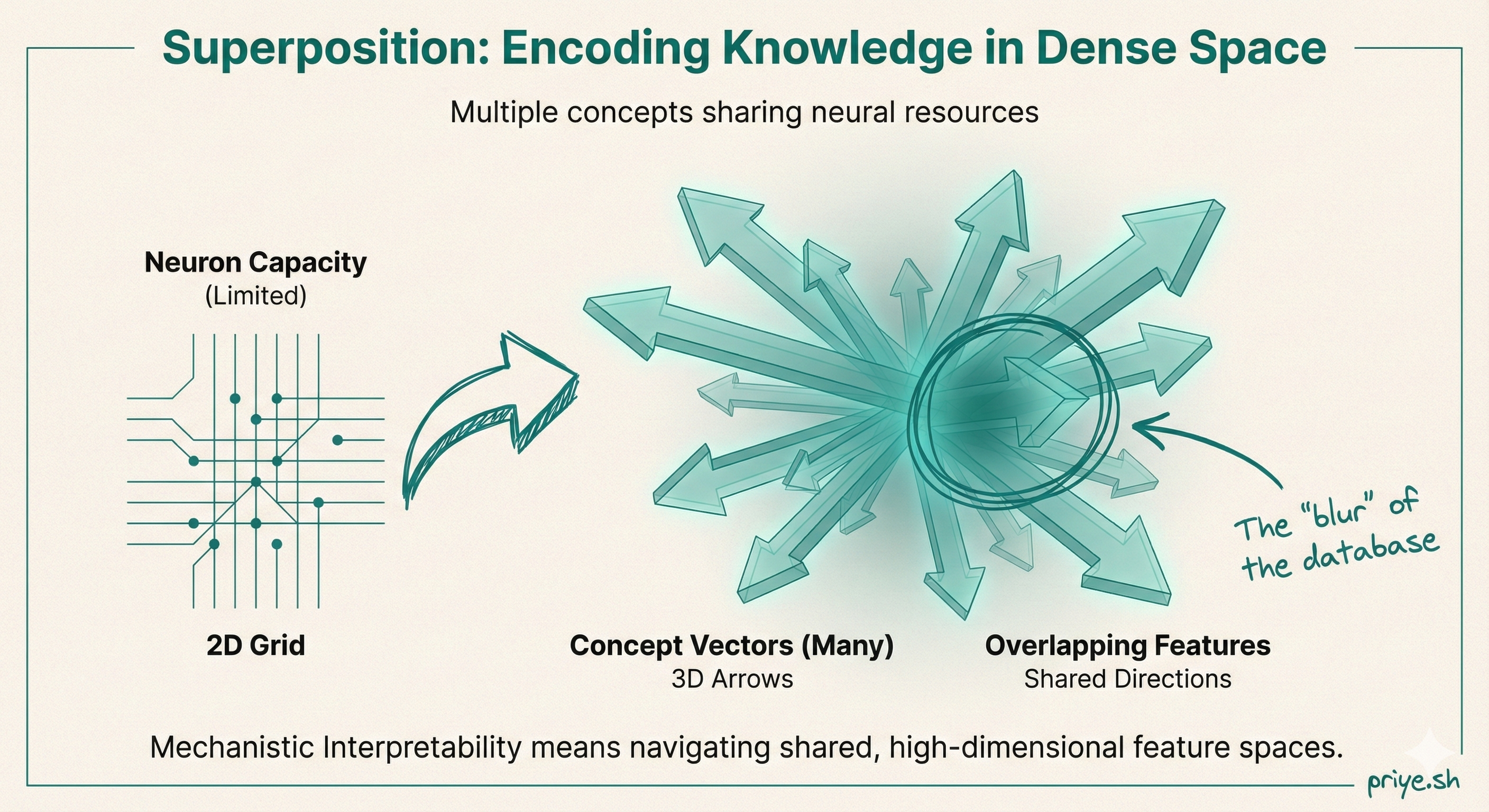
By identifying the specific vector direction for "Golden Gate Bridge" and artificially clamping it, Anthropic could force the model to mention the bridge in unrelated contexts, or conversely, blind the model to its existence. This is the primitive equivalent of a SELECT statement. Instead of prompting for an output, we are inspecting the internal state.
While Anthropic and Google DeepMind (with their Gemma Scope release) are leading the research, startups like Normal Computing are pushing this frontier commercially. They are building "probabilistic" and "thermodynamic" AI systems that allow us to audit and verify what the model knows without running a full inference pass, effectively turning the "Black Box" into a "Glass Box."
THE 'WRITE' PROBLEM: WHY FINE-TUNING IS NOT THE ANSWER
Whenever I discuss this thesis, the immediate counter-argument is: "How is editing any different from just fine-tuning a model?" We need to have this pre-emptively answered. Fine-tuning is not a database write operation; it is a global optimization process. Fine-tuning updates weights across the entire network to minimize loss on a new dataset. It changes the model's "style" or general behavior. Also, Fine-tuning takes hours or days. A database UPDATE must happen in milliseconds.
The solution lies in Model Editing techniques like ROME (Rank-One Model Editing) and MEMIT (Mass-Editing Memory in a Transformer). These methods allow us to locate the specific feed-forward layers where a fact is stored and mathematically compute a weight update that changes only that fact, minimizing collateral damage to the rest of the model.
This is the "Write" operation for the Neural Database. It is still brittle - as the Gupta paper highlights (creating a model at scale leads to the model losing reasoning capability and eventually collapses, a phenomenon called disabling edits), we cannot yet scale this to millions of updates - but it proves that direct weight manipulation is possible without a full backward pass.
THE INFRASTRUCTURE TRIAD: INTERPRETABILITY, STEERABILITY, QUANTIZATION
If the "Neural Database" is to replace the RAG stack, three fundamental problems must be solved in concert:
1. Interpretability: We need an automated way to map concepts to directions in activation space. Just as a SQL database has an index to find rows quickly, we need scalable SAEs that can index the massive vector space of the model in real-time. Startups like Goodfire are trying to productize this into an API surface: “programmable access” to what a model internally represents.
2. Editing + Versioning (The Write Path): ROME and MEMIT are the first credible proof that we can compute targeted weight updates for specific facts, and even batch thousands of edits, without full retraining. The missing infrastructure layer is everything databases take for granted: conflict detection (two edits that collide), rollback (undo a bad patch), and an auditable diff history.
3. Integrity + Governance: A database is only useful if you can trust it under adversarial use. For a Neural Database, the equivalent of integrity constraints is continuous evaluation for truthfulness, leakage, and regression after every write, plus enforceable policy boundaries that don’t crumble under prompt injection. This is where the LLM eval and security layer stops being “niche nice to have” and starts looking like the checksum, constraint, and access-control layer for mutable weights.
As we solve for interpretability and model editing, we will move from a world of "frozen" intelligence to "fluid" knowledge bases. For founders, one untapped opportunity may lie not in building another RAG infrastructure, but in building the SQL for the Neural Age.