Predictions for 2026
Scorecard framework for a VC
Venture attribution is notoriously difficult. Founders pivot, markets move, products mutate, and success ends up being downstream of a thousand unpredictable variables.
Inspired by Tomasz Tunguz’s annual tradition of publishing predictions and then grading them publicly, I'm forcing myself to write down what I believe before the outcomes are obvious. And creating a clean way to score myself a year later.
These aren’t macro trends of AI adoption or robotics domination (which will be much above my pay grade) but narrower wedges where I think real winners get built. The predictions increasingly get crazier from 1 to 5, because why not?
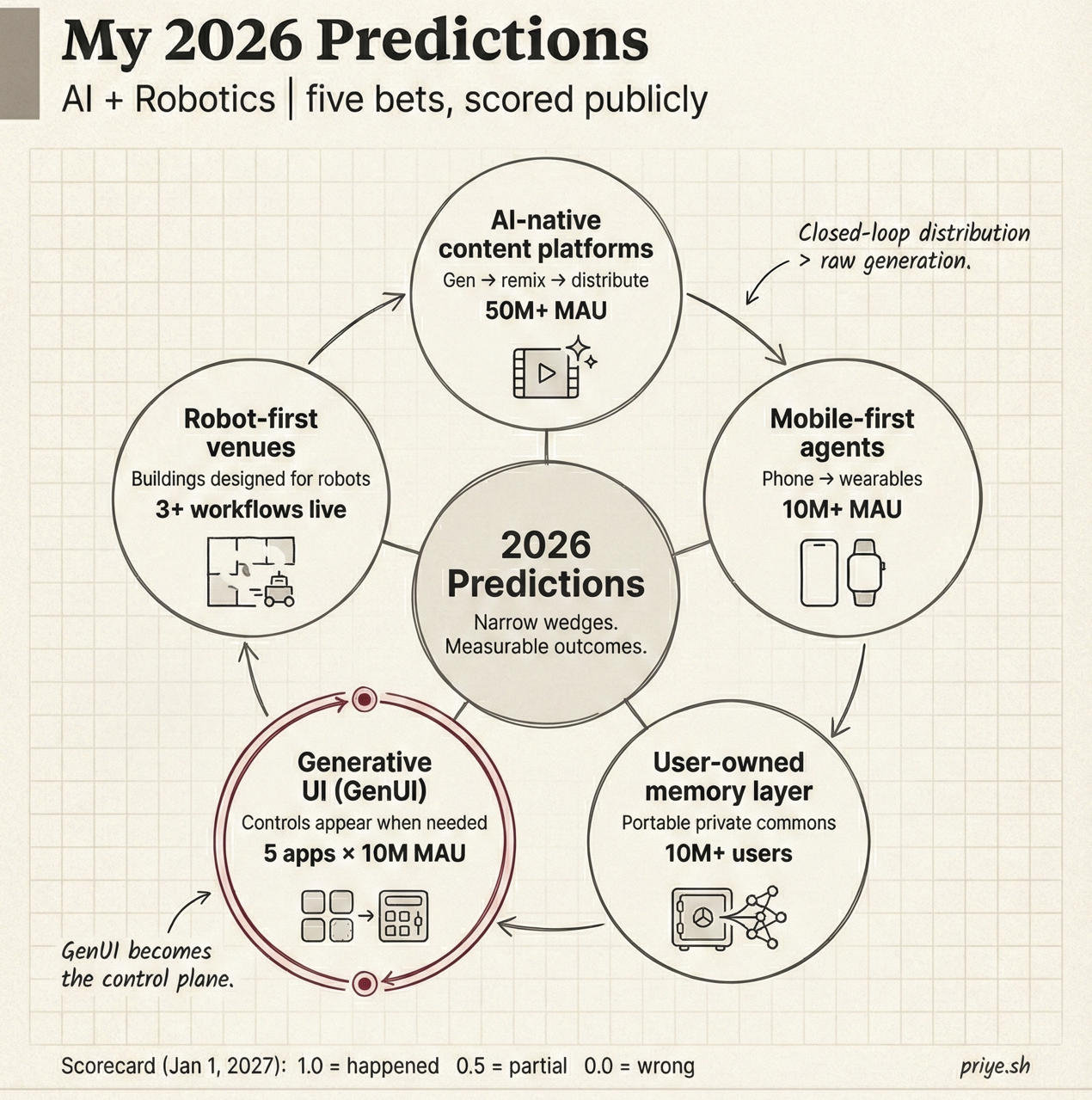
1) AI-native content platforms will become the first true “closed loop” media companies
We’re going to see the first breakout consumer platform where content creation and distribution are one integrated system, not two separate products stitched together.
The first wave of AI content was “generator-first”: make a thing, export it, post it somewhere else. 2026 is when we get “feedback-first”: a platform that uses engagement data to continuously steer generation away from the uncanny, low-signal AI slop and toward content that actually holds attention. Unlike TikTok, which uses engagement data to sort human content, this platform will use engagement data and Reinforcement Learning to steer the generation itself.
Prediction: by end of 2026, at least one AI-native full-stack content platform (create → remix → publish → distribute → optimize) crosses 50M+ MAU globally.
What would prove it: the platform’s content is native AI-generated, has self-distribution, with signals to improve next iterations of generation.
What could break it: AI content optimizes too hard for shallow engagement and becomes spammy; traditional social media (read Meta) adopts an aggressive AI-generation-first approach.
2) Agents go mobile-first (and spill into wearables)
Wave 1 of agents was enterprise workflows, primarily adding agentic substrates to Enterprise SaaS applications
Wave 2 was consumer workflows on web and desktop, driven by computer use models
Wave 3 is mobile because that’s where the richest primitives live: location, camera, notifications, motion, ambient context, and heavy consumer use
The hard part for Wave 3 is that Apple and Google are walled gardens by design, and they aggressively restrict sensitive permissions. By 2026, we will see a platform that bypasses the traditional app grid entirely. Instead of opening Uber, DoorDash, or Expedia, you will interface with a single mobile agent that utilizes mobile-native primitives (location, payments, biometrics) to execute tasks across these verticals. Wearables make this even more interesting because they’re naturally “always-on” context collectors. This platform will not be an OS, but it will move towards rendering the OS invisible
Prediction: by end of 2026, a mobile-first agent platform crosses 10M+ MAU
What would prove it: “agentic behavior” is native, not just chat in a mobile wrapper.
What could break it: distribution choke points (App Store policies) and privacy blowback.
3) Memory gets decoupled from apps (consumer-owned “private commons”)
Right now, “memory” is an application feature. It sits inside a proprietary database, controlled by the developer. Memory ends up being the MOAT for every AI application. Arguably, this is what is keeping ChatGPT surviving against the big distribution of Gemini.
Memory ownership will shift to the consumer in 2026. In this architecture, the user maintains a secure, structured graph of their interactions and values. When they engage a new app, they "grant access" to this memory layer. This kills cold start, enables cross-app context, and reduces duplicated infrastructure.
Prediction: by end of 2026, one consumer product crosses 10M+ users and normalizes the idea of user-owned portable memory (exportable, permissioned, cross-app).
What would prove it: apps integrate via a memory permission layer, it becomes a key platform to chat with yourself.
What could break it: a good enough wedge does not evolve, for which, consumers are ready to pay enough for memory storage/retrieval to be feasible.
4) Generative UI becomes the real control plane for AI apps
Most AI products are fighting the same problem: LLMs are flexible, but software interfaces are rigid. Static UI is a structural inefficiency. It optimizes for the median user and forces everyone else to do cognitive labor to adapt. This is why modern SaaS needs an entire industry of enablement and training.
The next step-function isn’t “better dashboards.” It’s GenUI: interfaces that adapt probabilistically to user intent in real time. Instead of a dashboard with 50 buttons (48 of which you don't use), the model generates the specific controls you need, the moment you need them. While voice and natural language will grow, they will never absolutely replace GUIs - sometimes you just need a button. But that button should only exist when you need it.
Prediction: by end of 2026, “GenUI” becomes a commonly accepted pattern and shows up in at least a few high-usage apps as a default experience (not a demo mode).
What would prove it: 5 apps, with each having 10M MAU, adopt the Generative UI paradigm.
What could break it: All of the three: generation consistency, user preference prediction, and generation latency/cost are not solved.
5) The physical world will start getting “agent-first” the same way the web is
Humanoids are end-state robotic form factor, partly because the world is designed for humans. But the faster path to real deployments is the opposite move: change the world slightly to fit robots, instead of waiting for robots to master every messy edge case of the human world.
Re-architecting that parallel systems or tiny fish are doing for the web would happen for the physical world first time in human-inhabited commercial spaces. Robotic labs are already creating staged environments to mimic the real world for robot training. By 2026, we’ll see the first commercially successful venue that’s intentionally designed robot-first (not just “using robots”), where robots and humans cohabitate smoothly, and the space quietly optimizes for continuous robotic workflows like delivery, cleaning, restocking, and waste handling.
Prediction: By end of 2026, at least one hospitality or food-service venue (hotel / restaurant / serviced-living) becomes a breakout example of a robot-first building + ops design, supporting 3+ robot workflows running autonomously in production
How to check: The venue’s layout + operations clearly bake in robot primitives (auto-doors/elevator integration, robot staging + charging zones, standardized pickup/drop points, predictable navigation pathways), and robots operate daily with zero human babysitting while guests experience the space as “normal.”
What could break it: Reliability and service ops layer for robotic fleets is built, customer experience degrades (“this place feels like a robot lab”), or safety/regulatory friction kills scale before the model becomes repeatable
I have set up an LLM as a judge setup to grade these on January 1, 2027 using a simple rubric:
1.0 = clearly happened
0.5 = partially happened
0.0 = didn’t happen / wrong direction