Why AI Memory Must Decouple from the Application
The thesis for user-centric memory ownership
Over the last year, Google’s Gemini has quietly hit technical parity with OpenAI and in a few multimodal workflows, it’s arguably better. Claude's ecosystem around Claude Code, computer use, and now cowork is clearly ahead in the technical workflows. And while they grew comparatively much faster than ChatGPT, they did not steal users out of the OpenAI ecosystem.
In our investment team, we often discuss that it would require a step change for a user to move out of ChatGPT to a different model. That is the power of intial mindshare Open AI has.
I believe mindshare is a leaky bucket, and the plug in that is memory.
For the past two years, users have been unintentionally training ChatGPT on their preferences, coding styles, and project histories. To switch to Gemini is to reset one’s digital cognition to zero.
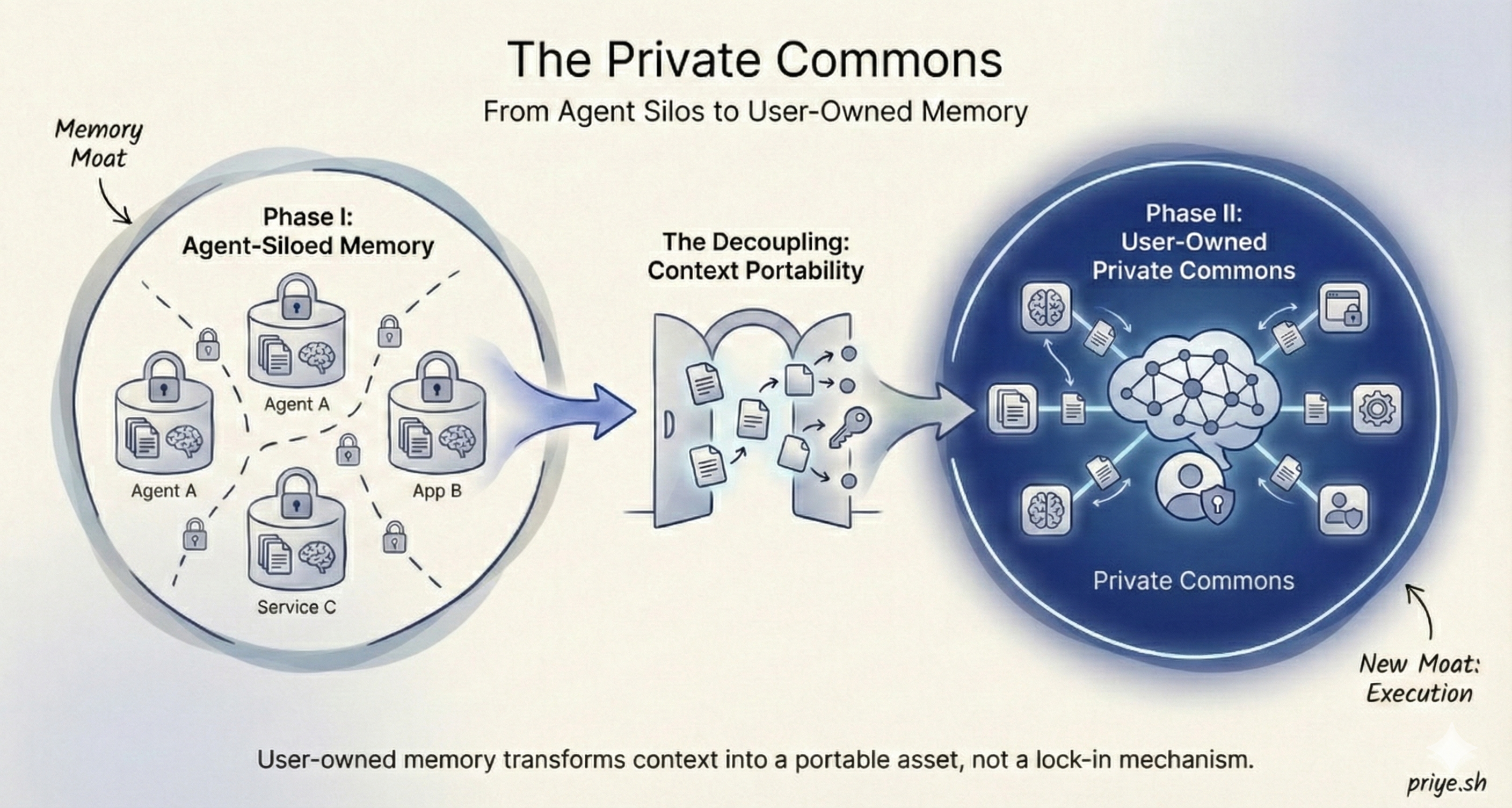
However, this architecture, where memory is tightly coupled with the model, is fundamentally inefficient. It creates data silos that prevent the 'compounding of cognition.' If I tell ChatGPT about my portfolio company's Q3 metrics, that context is invisible to my coding agent in Cursor or my scheduling agent in Motion. We are currently rebuilding our context from scratch in every vertical application. This is the 'Agent-Centric' era of memory, and it is hitting diminishing returns.
My thesis argues that this application-siloed memory is a temporary inefficiency. I believe in 2026, we will move toward 'Theory of Private Commons,' where AI memory is decoupled from the application layer and consolidated at the consumer level.
THE THEORY OF PRIVATE COMMONS
Analyzing the structural shift in where memory resides, I categorize this evolution into two phases.
Phase I: The Agent Layer (Current State)
Currently, memory is an application feature. It is stored in a proprietary vector database controlled by the app developer. The user has no access to the raw embeddings and cannot port them. This benefits the incumbent but hurts the ecosystem.
Phase II: The Consumer Layer (Future State)
This is the thesis I am betting on. I strongly believe that memory will migrate to the consumer level. This aligns with the theory of private commons: data utility is maximized when ownership is concentrated at the source (the user) rather than fragmented across the sink (the applications).
In this architecture, the user maintains a consolidated 'Private Commons'—a secure, structured graph of their interactions, decisions, and values. When a user engages an application, they selectively supply this memory. The benefits of having a common corpus of memory at the consumer level are twofold: it reduces cold-start friction for new apps to zero, and it allows for cross-pollination of context - all while preserving sensitive data. This transforms the user's history into the ultimate context engineering piece; instead of an agent guessing intent, the user's infrastructure injects precise, historical context before the query hits the model.
TECHNICAL DEEP DIVE: BEYOND VECTORS
How do we build this? Many founders mistake this for a 'Personal Vector Database' problem. However, vector databases (semantic search) are insufficient for human-like memory. Human memory is relational and temporal, not just semantic.
If I ask an agent, "How is my thesis evolving?" a vector search returns documents containing the word "thesis." It lacks the temporal understanding of evolution, the delta between document A (last month) and document B (today). It also lacks relational understanding of opinions, claims, and facts, and how do they all combine into forming my thesis.
To build a true Private Commons, we need architecture that models relationships and time. This is where companies like Zep AI, Mem0, and frameworks around GraphRAG are innovating. They are not just storing embeddings; they are building Temporal Knowledge Graphs.
With the amount of research efforts behind AI memory and the critiality of it, I believe just the technical architecture of it would not be a key bottleneck in the future.
The Protocol Layer: MCP
The decoupling of memory requires a standard interface and data streaming layer. The right chunk of memory needs to be shared with an AI application at the right time, with controls at the user level.
MCP for Personal memory could act as a universal connector between data sources (memory) and AI systems. It is effectively the 'USB-C for AI context.' However, there needs to strong engineering.
IMPLICATIONS: WHERE IS THE MOAT?
If we accept that memory will decouple from the agent, where does value accrue? The landscape shifts from vertical integration to horizontal stratification.
1. The End of the Data Moat : If users own their memory, a SaaS app cannot lock you in with your own data. This forces companies to compete on execution rather than retention.
With memory commoditized and portable, the winners will be those with the best agentic reasoning and execution. When context is free, execution becomes the premium asset. The moat shifts from "I know you best" hence "I can do this task better" to "best overall systems"
2. The Security Wrapper : If users own a 'Private Commons,' the attack vector shifts. 'Memory Poisoning' where a malicious prompt injects false information into your long-term context becomes a critical threat. Several top-tier research teams are building for this problem, but for the application-centric memory posture.
COUNTERARGUMENTS: THE OS THREAT
1. The strongest bear case against independent 'Memory Infrastructure' is the Operating System.
Microsoft, Apple and Google are uniquely positioned to win the memory war not because their technology is better, but because they own the kernel. Microsoft's Recall feature is the first attempt at this thesis from a strong OS incumbent. If an OS allows third-party agents to query this index via an API, then the 'Memory Layer' simply becomes a feature of the OS.
However, the counter-counterargument is trust and cross-platform portability. An Apple Semantic Index is useless if I switch to a Windows workstation or use a Linux-based cloud environment. A true Private Commons must be platform-agnostic.
2. The wedge which provides substantial and low time-to-value ROI to the user. Microsoft's Recall failed at this, ambient devices like Rewind did not achieve the level of scale as was expected. Is this next wedge an omnipresent agent on the mobile and PC or a new wearable form factor or just an application in form of a companion? Predicting this is where I'm spending a lot of my time lately.
If you are building towards this vision, I would love to talk and share more.
I am building a prototype of my own Memory - 1300+ ChatGPT threads; 449 Pitch meetings, 18 stories and articles and countless MBA assignments. The efficiency gains of a consolidated, user-owned memory layer—a Private Commons—are too great to ignore. It transforms memory from a lock-in mechanism into a tradable asset. For founders and investors, the next unicorn won't be another foundation model; it will be the infrastructure that allows us to take our mind with us, wherever we go.