ThoughtBot
Adversarial multi-agentic LLM Panel for VC research
VC is the business of generating alpha from convictions, but most investors would admit the same uncomfortable truth: once you believe something, you start optimizing your research to defend it. Conviction decays into confirmation bias. You stop being curious in the right places. The memo becomes a marketing document for your partnership, not a stress test of reality.
This post introduces ThoughtBot: an adversarial AI workflow designed not to generate content, but to force truth seeking behavior through a structured critique loop. The goal is simple: move from fluent generative output to verifiable, high signal investment theses.
ThoughtBot is my attempt to engineer a solution to that messy middle. It is not an autopilot for thought leadership. It is a compact editorial desk, a research analyst, and a skeptical senior editor wired into a workflow that forces explicit assumptions, demands evidence, and rejects drafts that are boring or unsupported.

Phase 1 is synthesis plus gap mapping. Most LLM workflows are prompt in, draft out. ThoughtBot forces intermediate “thinking artifacts” before prose. Voice Extractor takes raw input, usually voice notes or messy bullets, and isolates (1) the core thesis, (2) the intended audience and tone, and (3) the implicit claims being made.
Then the Gap Mapper does the critical work: it identifies absence. If you say “adoption is accelerating,” it asks where the time series data is. If you claim “the architecture is converging,” it asks for mechanism and counterexamples. This is the main anti slop lever. Instead of letting the model fill uncertainty with plausible sounding filler, it forces a Gap List that dictates what must be verified before writing can proceed.
Research is triggeredclosely following the Gap List. The system is not asked to “research the market.” It is asked to retrieve specific numbers, case studies, or technical references that resolve explicit holes in the argument.
Phase 2 is the QA gauntlet, and it is the center of the system. The draft enters a critique loop with an actual veto. In standard generative workflows, the model is optimized to be agreeable. Here, it is optimized to push back.
Three agents run in parallel, each owning a different failure mode. The FactChecker verifies every claim against the research context. It maintains a claim ledger: if a sentence asserts a fact, it needs a corresponding citation in the retrieved context or it gets flagged for deletion.
The InsightChecker filters for novelty and density. It flags clichés, empty corporate speak, and sentences that could apply to any company. The standard is blunt: if removing a sentence loses no information, it should not exist. This is how you make the output feel like a real investor wrote it, not like a model did.
The EngagementChecker evaluates structure, not virality. Does the piece have a clear throughline. Are examples concrete enough to keep a smart operator reading. Does the draft anticipate the reader’s skepticism rather than assuming agreement.
These streams feed into the Editor gate. The Editor behaves like a senior partner reviewing an associate memo. It does not do cosmetic edits. It rejects shallow sections and issues targeted revision instructions, for example: “Section 2 lacks mechanism, add one example and one counterexample,” or “This paragraph reads salesy, strip adjectives and re-anchor in evidence.” The loop repeats until the draft crosses a defined threshold. Only then is the text locked.
Phase 3 is visual orchestration, and it only runs after the text is locked. The rule is that visuals are editorial reinforcement, not decoration. The ImagePlanner scans the finalized structure and decides where a visual actually increases understanding. Data claims get charts. Mechanism claims get diagrams. Ecosystem complexity gets market maps. Then the Prompt Generator produces image prompts that follow a strict visual identity so the result looks like one cohesive artifact, not random images stapled onto a post.
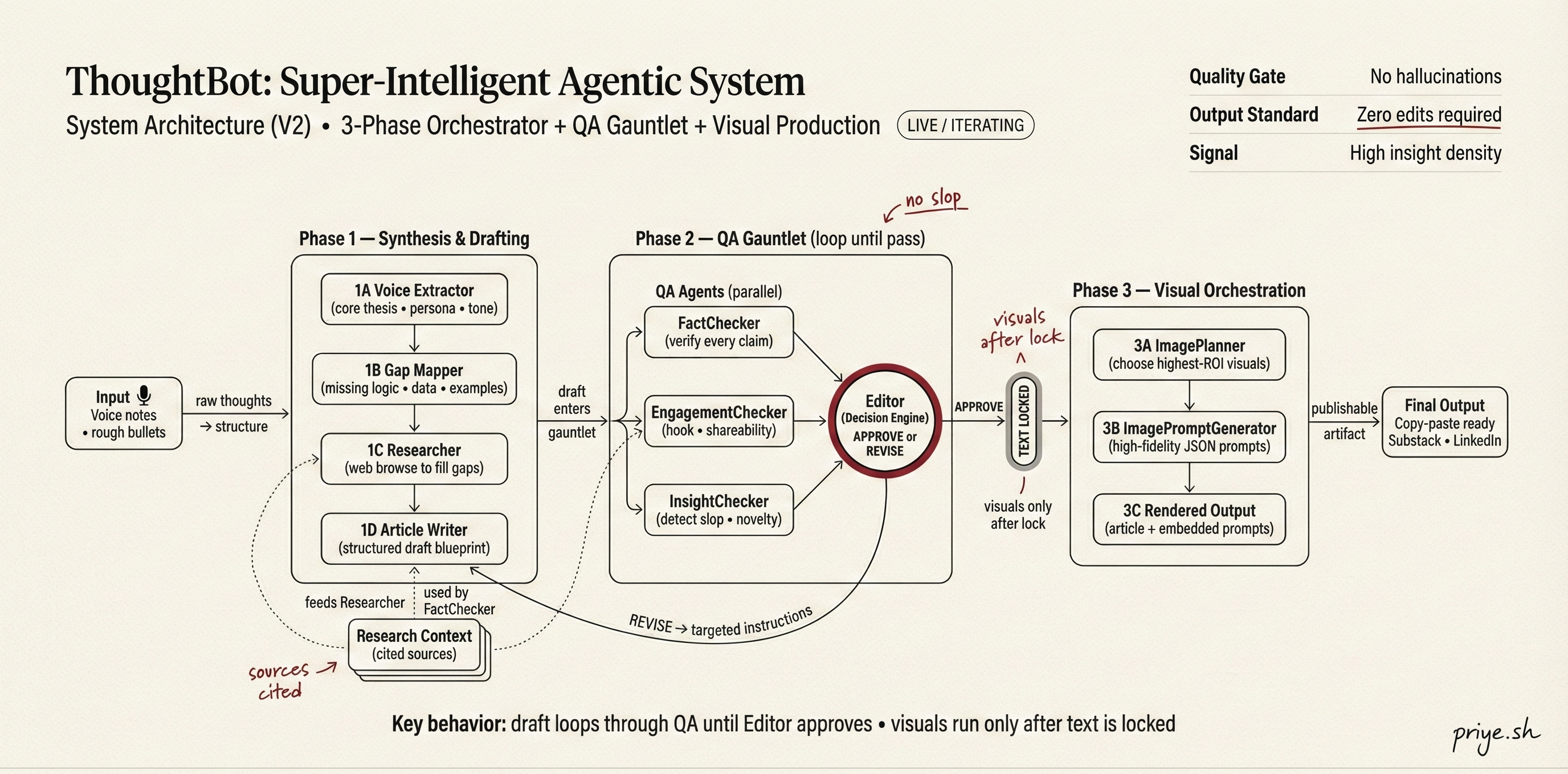
Under the hood, this is a workflow engine orchestrating narrow agents that communicate via structured outputs rather than free text. Each step emits parseable objects such as a Gap List, claim ledger, and critique instructions. That makes the system auditable: you can see why a draft was rejected, what evidence was missing, and what specific constraint forced a rewrite.
The system also has comprehensive human-in-the-loop feedback built in at every step so that the entire system can be steered in the right direction based on the user's needs. The UI reflects that philosophy. It is designed as a glass box where the logs show what the system is doing and why, with quick edits, comprehensive feedback mechanism, and model steering control buttons built in.